(Viber, Whatsapp, Cell) +977 9851022814

There’s a reason trekkers from every corner of the world keep coming back to Nepal. In just a few days of walking, you can go from subtropical forest to glacial moraine, from terraced rice fields to a 5,000-meter pass with eight-thousanders on the horizon. No other country packs that much variety into such a walkable space.
But with hundreds of trails to choose from, picking the right one can feel overwhelming. Do you want the bucket-list icon or the trail nobody’s heard of? A week off work or a month-long expedition? Teahouse comfort or full camping wilderness?
This guide breaks down the top 10 best treks in Nepal — what makes each one special, who it suits, and what you’ll actually experience out there. With over 34 years of experience, Alliance Treks has guided travelers along every one of these routes, and we’ve built this list to help you find the trail that fits you.
Best for: First-time Himalayan trekkers chasing an icon
Max altitude: 5,545m (Kala Patthar)
Typical duration: 12–14 days
Some treks need no introduction: the Everest Base Camp Trek. The journey to the base of the world’s highest mountain starts with one of the most dramatic flights on earth — a short hop into Lukla, where the runway ends against a mountainside.
From there, the trail winds through Sherpa villages, past prayer wheels and mani stones, and up to Namche Bazaar, the bustling trading hub that serves as the gateway to the high Khumbu. Tengboche Monastery offers one of the most photographed backdrops in Nepal, while the sunrise climb up Kala Patthar delivers the Everest view you came for.
What surprises most trekkers isn’t the mountains — it’s the people. Sharing a teahouse dining room with trekkers from a dozen countries, all pushing toward the same goal, creates a camaraderie that’s hard to replicate anywhere else.
Good to know: Pair it with Gokyo Lakes or the Three High Passes if you want a longer, less-trafficked version of the same region.
Best for: Trekkers who want maximum landscape diversity
Max altitude: 5,416m (Thorong La Pass)
Typical duration: 12–16 days
If there’s one trek that showcases everything Nepal has to offer, it’s this one. The Annapurna Circuit starts in green farmland and subtropical valleys, climbs through rhododendron forest, and ends in the wind-carved desert landscapes of Mustang — all within a single continuous route.
The crossing of Thorong La Pass at 5,416m is the physical high point, but the cultural journey is just as rich: Gurung villages in the lower valleys give way to Thakali and Tibetan-influenced communities higher up, each with distinct food, architecture, and traditions.
Road construction has changed parts of the circuit in recent years, but alternative trails and NATT routes keep the walking experience intact for those who know where to go.
Best for: Short trips, beginners, and trekkers short on time
Max altitude: 4,984m (Tsergo Ri, optional)
Typical duration: 7–10 days
Just a day’s drive from Kathmandu, Langtang offers serious Himalayan scenery without the long approach or the crowds of Everest and Annapurna.
The valley is framed by Langtang Lirung and Ganesh Himal, and the trail passes through Tamang villages where Tibetan Buddhist culture remains deeply rooted. Langtang National Park protects a genuinely wild ecosystem — red pandas, langur monkeys, and dense rhododendron forest included.
There’s also a quieter reason this trek matters. Langtang Village was devastated by the 2015 earthquake and rebuilt by its own community. Trekking here directly supports that recovery, which adds real meaning to every night spent in a local teahouse.
Best for: Experienced trekkers seeking Annapurna-level scenery without the crowds
Max altitude: 5,160m (Larkya La Pass)
Typical duration: 14–16 days
Circling the world’s eighth-highest mountain, the Manaslu Circuit is what the Annapurna Circuit felt like twenty years ago — remote villages, minimal road access, and stretches of trail where you’ll see almost nobody.
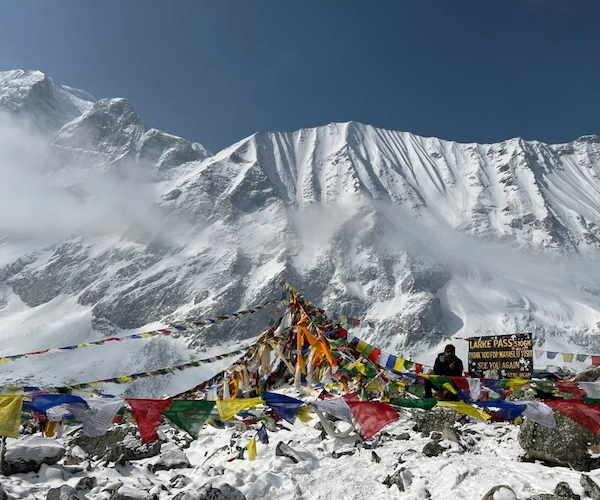
The route climbs through the Budhi Gandaki gorge into high Tibetan-influenced settlements before crossing Larkya La Pass at 5,160m, one of the most spectacular pass crossings in the country.
Because it’s a restricted area, you’ll need a special permit and a licensed guide — which is precisely why it stays so uncrowded.
Best for: Beginners, families, and travelers with limited time
Max altitude: 3,210m (Poon Hill)
Typical duration: 4–7 days
Not everyone has three weeks. The Poon Hill trek proves you don’t need them.
In under a week, you’ll walk through rhododendron forest and Gurung villages to a sunrise viewpoint that delivers a full panorama of the Annapurna and Dhaulagiri ranges — arguably the best views-to-effort ratio anywhere in Nepal.
It’s low altitude, well-supported by comfortable teahouses, and gentle enough for children and older travelers. Time it right in spring, and the entire forest turns red and pink with blooming rhododendron.
Best for: Culture-focused travelers and photographers
Max altitude: 3,840m (Lo Manthang region)
Typical duration: 12–16 days
Closed to outsiders until 1992, Upper Mustang remains one of the most culturally intact Tibetan Buddhist regions anywhere — including Tibet itself.
This is high-desert trekking: ochre cliffs, wind-carved canyons, ancient cave dwellings carved into rock faces, and the walled city of Lo Manthang, once the capital of an independent kingdom. Centuries-old monasteries hold murals and manuscripts that simply don’t exist elsewhere.
Because Mustang sits in the Annapurna rain shadow, it’s also one of the few regions in Nepal that can be trekked during the monsoon.
Good to know: A restricted-area permit is required, and it isn’t cheap — but the exclusivity is a large part of what keeps this region so well preserved.
Best for: Seasoned trekkers wanting genuine remoteness
Max altitude: 5,143m (Sele La/base camps)
Typical duration: 20–24 days
Nepal’s far-eastern corner sees a fraction of the traffic found in Everest or Annapurna, and the Kanchenjunga Circuit is the reason to go.
The trail climbs from subtropical lowland forest through terraced farmland and rhododendron woods into glacial territory beneath the world’s third-highest peak. Along the way, you’ll pass through Limbu and Rai communities whose cultures are distinct from the Sherpa and Gurung populations most trekkers encounter.
It’s long, demanding, and logistically complex — which is exactly why it rewards those who commit to it.
Best for: Trekkers who want Everest views without Everest crowds
Max altitude: 5,357m (Gokyo Ri)
Typical duration: 12–14 days
Same region, different experience. Instead of following the main EBC trail, the Gokyo route heads up a parallel valley to a chain of turquoise glacial lakes sitting at nearly 5,000m.
The climb up Gokyo Ri is the payoff: from the summit, four of the world’s six highest peaks — Everest, Lhotse, Makalu, and Cho Oyu — are visible in a single panorama. Below, the Ngozumpa Glacier, the largest in Nepal, stretches down the valley like a frozen river of rubble.
Many trekkers now combine Gokyo with Everest Base Camp via the Cho La Pass for the best of both.
Best for: Complete beginners, families, and weekend trekkers
Max altitude: ~3,650m
Typical duration: 5–7 days
Starting practically on Kathmandu’s doorstep, Helambu is one of the most accessible trekking regions in the country — no domestic flight, no long drive, no altitude concerns.
The trail winds through forest, terraced farmland, and Sherpa and Hyolmo villages, offering a genuine cultural experience at a very manageable pace. It’s a great first trek, an excellent family option, and a solid choice if you’ve got a week and want to actually walk rather than spend half the trip in transit.
Best for: Experienced trekkers seeking true wilderness
Max altitude: ~4,870m (Makalu Base Camp)
Typical duration: 18–22 days
The fifth-highest mountain in the world sits at the end of one of Nepal’s least-traveled trails. There’s no easy access, limited infrastructure, and very few other trekkers.
What you get instead is the Makalu Barun National Park — a protected area spanning subtropical forest to high-alpine terrain, home to some of the richest biodiversity in the Himalaya. The final approach to base camp, beneath Makalu’s massive south face, is as raw and dramatic as Himalayan trekking gets.
This one demands proper preparation, but for trekkers who’ve already done the classics, it’s the natural next step.
| If you want… | Choose |
|---|---|
| The iconic bucket-list trek | Everest Base Camp |
| Maximum landscape variety | Annapurna Circuit |
| A short trek near Kathmandu | Langtang Valley or Helambu |
| Big views in under a week | Ghorepani Poon Hill |
| Remote trails, few crowds | Manaslu Circuit or Kanchenjunga |
| Deep Tibetan culture | Upper Mustang |
| Everest views, fewer people | Gokyo Lakes |
| True wilderness expedition | Makalu Base Camp |
The best trekking seasons in Nepal are autumn (September–November) for the clearest mountain views and most stable weather, and spring (March–May) for blooming rhododendron forests and warmer temperatures. Winter works for lower-altitude treks, while monsoon season suits rain-shadow regions like Upper Mustang.
Whichever route calls to you, the difference between a good trek and a great one usually comes down to planning — proper acclimatization, the right pace, experienced guides, and logistics that actually work when weather or conditions shift.
Since 1992, Alliance Treks & Expedition has been guiding travelers across every one of these trails, from first-timers on Poon Hill to seasoned mountaineers heading into Makalu. We build each itinerary around your fitness, schedule, interests, and budget — not the other way around.
Get in touch and let’s find the right trail for you.
Ghorepani Poon Hill, Langtang Valley, and Helambu are the three most beginner-friendly options, offering excellent mountain scenery at manageable altitudes and durations.
Autumn (September–November) offers the clearest views and most stable conditions, while spring (March–May) brings blooming rhododendrons and warmer weather.
Current regulations require a licensed guide for most trekking routes, and restricted regions like Manaslu and Upper Mustang require both a guide and a special permit.
It varies widely — Poon Hill needs only basic walking fitness, while Kanchenjunga and Makalu demand strong fitness and prior high-altitude experience.
Makalu Base Camp, Kanchenjunga, and Manaslu see significantly fewer trekkers than the Everest and Annapurna regions.
Trekking durations vary from short 3–7 day routes such as Poon Hill and Helambu to longer expeditions of two to three weeks or more, including Manaslu, Makalu, and Kanchenjunga.
The cost depends on the route, duration, accommodation, permits, transportation, guide and porter services, and group size. Shorter tea-house treks generally cost less than remote or restricted-area expeditions.
Essential items include layered clothing, comfortable trekking boots, a waterproof jacket, warm layers, a sleeping bag, sunscreen, sunglasses, a headlamp, water purification, personal medicines, and trekking poles.
Everest Base Camp, Gokyo Lakes, Annapurna Base Camp, Manaslu Circuit, and Kanchenjunga offer spectacular Himalayan scenery, with the views varying by route, season, and weather conditions.
Yes. Several lower-altitude routes are suitable for people with little or no previous trekking experience. Beginners should choose a route appropriate for their fitness level and allow enough time for acclimatization on higher-altitude treks.
Alliance Treks & Expedition Pvt. Ltd. Once is not enough for naturally and culturally Himalayas